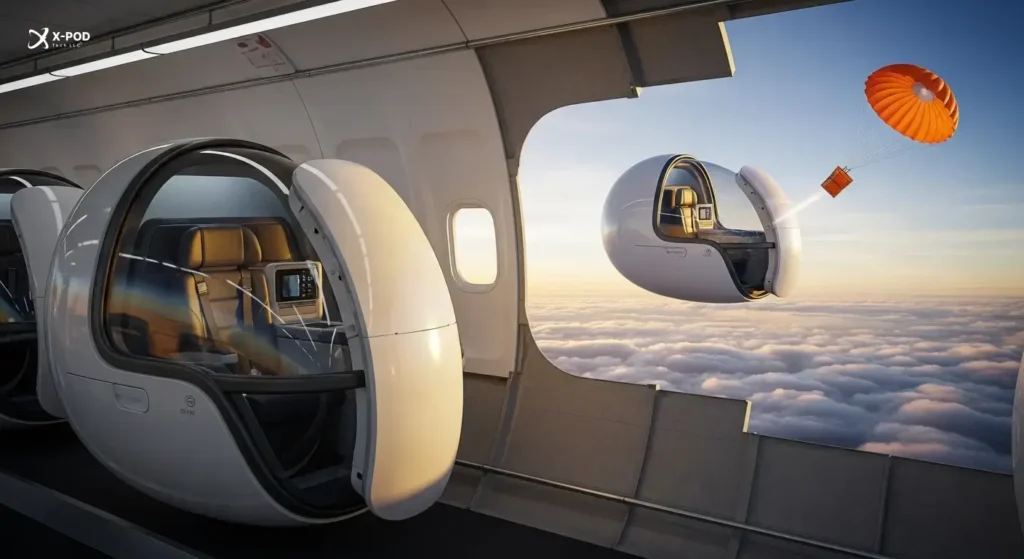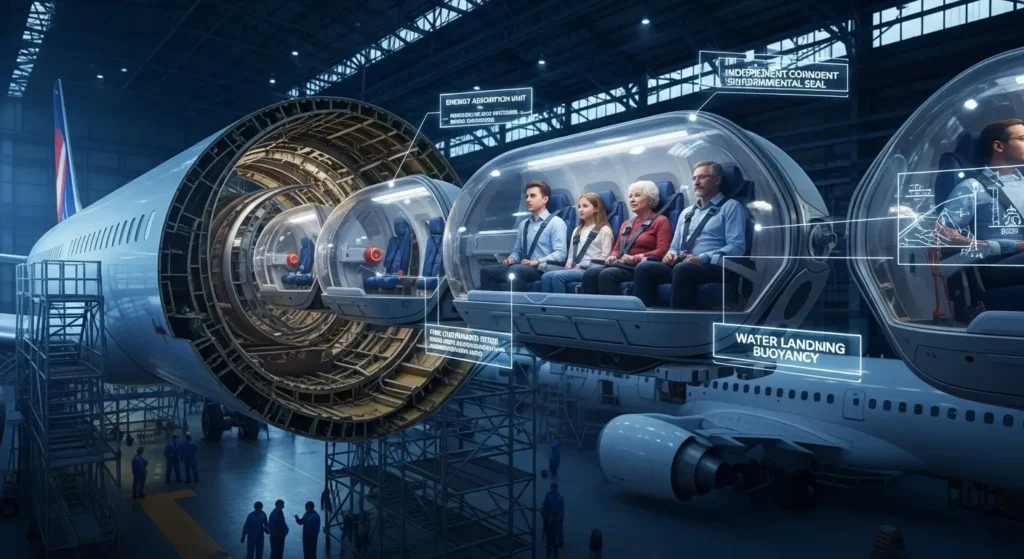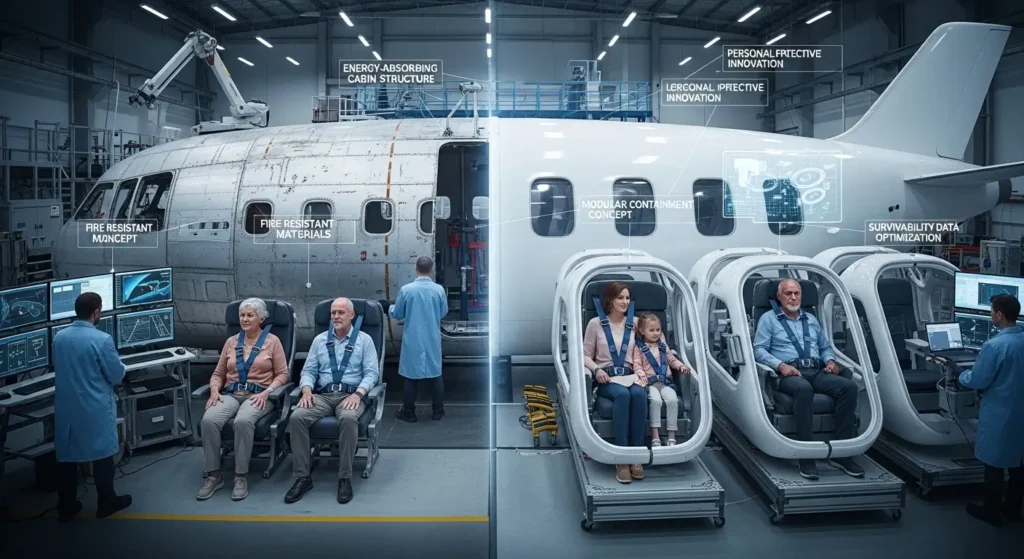
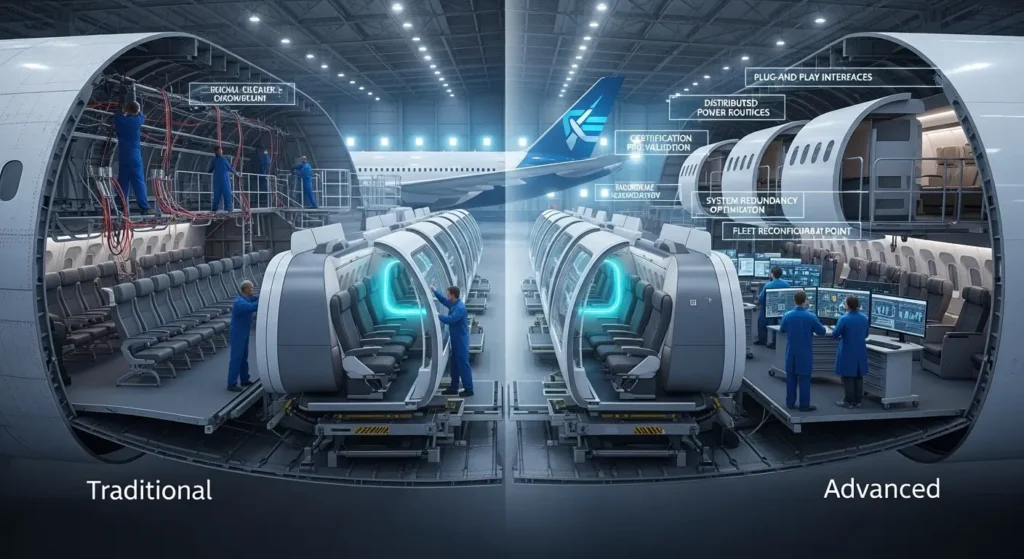
Cabin architecture has traditionally been associated with passenger comfort, branding, and space optimization. However, modern aerospace engineering increasingly recognizes that modular aircraft cabin design plays a far more strategic role. Cabin architecture influences safety performance, system integration, maintenance efficiency, weight distribution, and lifecycle cost.
For OEMs and technical decision-makers, the aircraft interior is no longer a secondary consideration. It is an integrated subsystem that interacts with avionics, environmental controls, structural components, and operational economics.
As aircraft programs evolve toward greater efficiency and adaptability, cabin design must align with broader engineering objectives. The shift toward modularity reflects this systems-based mindset.
Today’s future aircraft cabin technology is being shaped not just by passenger expectations, but by certification pathways, integration feasibility, and long-term fleet flexibility.
The Rise of Modular Engineering in Aerospace
Modular engineering has long been foundational in aerospace manufacturing. Engines, avionics, and control systems are developed as modular units to allow easier integration, testing, and maintenance. The same principles are now increasingly influencing aircraft interior innovation.
Modularity in cabin design refers to creating discrete, self-contained units that can be integrated, replaced, upgraded, or reconfigured without requiring structural redesign of the airframe.
Several industry forces are driving this shift:
Fleet Diversification
Airlines operate mixed fleets and require flexible cabin configurations across routes. Modular systems allow faster reconfiguration between high-density, premium, or specialty layouts.
Lifecycle Optimization
Aircraft operate for decades. Modular interior systems enable upgrades without grounding aircraft for extended structural modifications. This reduces downtime and protects asset value.
Maintenance Efficiency
Self-contained modules can be removed and serviced independently. This aligns with predictive maintenance models increasingly adopted across aviation systems.
Certification Streamlining
When properly designed, modular systems can be certified as repeatable units. Once approved, these modules can be integrated into multiple aircraft programs with fewer incremental certification burdens.
Innovation Cycles
Technology cycles now move faster than traditional aircraft development timelines. Modular cabin architecture allows incremental technology upgrades without redesigning the entire interior ecosystem.
The shift toward modular aircraft cabin design mirrors the broader aerospace philosophy: controlled complexity through structured integration.
For OEMs, this approach reduces risk while enabling adaptability.
Retrofit vs OEM Integration Challenges
One of the most significant technical considerations in cabin architecture is the distinction between retrofit implementation and OEM-level integration.
Both pathways present opportunities, but they involve fundamentally different engineering constraints.
Retrofit Integration
Aviation retrofit systems allow airlines to upgrade interiors on existing aircraft platforms. However, retrofits must operate within established structural limits, weight margins, electrical loads, and certification boundaries.
Key challenges include:
- Structural attachment constraints
- Power and data routing limitations
- Weight distribution compliance
- Fire safety recertification
- Downtime impact
Retrofits often require design compromises because the original airframe was not built with the new system in mind.
While modularity helps simplify installation, true optimization is limited by legacy architecture.
OEM Integration
In contrast, OEM aircraft cabin integration occurs during initial aircraft design and manufacturing. This allows:
- Structural reinforcement planning
- Dedicated system routing
- Optimized center-of-gravity calculations
- Integrated environmental controls
- Pre-certified installation pathways
From a systems engineering perspective, OEM integration provides the greatest opportunity to align cabin modules with structural, electrical, and safety frameworks from the outset.
However, OEM pathways involve longer development cycles, higher upfront validation requirements, and extensive regulatory coordination.
The strategic question for decision-makers becomes:
Is the solution designed to adapt to the aircraft, or is the aircraft designed to accommodate the solution?
Modular design principles can bridge this gap, but the engineering approach must account for integration context from the beginning.
Scalability and Certification Considerations
For OEMs and technical stakeholders, scalability is not simply a production concern. It directly influences certification strategy, supply chain reliability, and long-term program viability.
A well-executed modular aircraft cabin design must be scalable across multiple aircraft variants without introducing excessive revalidation requirements. This requires alignment with regulatory frameworks from the earliest design stages.
Certification as a Design Driver
In aerospace, certification is not an afterthought. It shapes architecture decisions from day one.
Cabin modules must comply with requirements related to:
- Structural integrity under dynamic loads
- Flammability and smoke toxicity standards
- Emergency egress compliance
- Electrical system redundancy
- Environmental control compatibility
When modules are designed as discrete units with standardized interfaces, certification pathways can become more structured. Instead of recertifying entire cabin systems, engineers can validate repeatable modules that integrate through predefined attachment and power points.
This reduces engineering ambiguity and improves approval predictability.
Scalability Across Platforms
Scalable cabin systems allow adaptation across:
- Narrow-body and wide-body variants
- High-density and premium configurations
- Regional and long-haul applications
However, scalability must account for structural load differences, floor beam reinforcement, and weight envelopes. A modular system cannot simply be dimensionally adjusted. It must be structurally and aerodynamically compatible with each airframe class.
This is where early collaboration between airframe manufacturers, interior suppliers, and regulatory consultants becomes essential.
Scalability without certification foresight introduces risk. Scalability with structured compliance strategy strengthens program resilience.
Designing for Redundancy and Isolation
One of the most forward-looking aspects of future aircraft cabin technology involves designing interiors not just for comfort and density, but for system resilience.
Traditional cabin architecture emphasizes open layouts to maximize movement and service efficiency. However, modular systems introduce the possibility of controlled redundancy and partial isolation.
Redundancy in Cabin Systems
Redundancy is a foundational principle in avionics and flight controls. Applying similar thinking to cabin subsystems can enhance operational stability.
Examples include:
- Distributed power routing
- Independent environmental modules
- Segmented communication systems
If a subsystem experiences malfunction, modular architecture can localize disruption rather than affecting the entire cabin environment.
Isolation as a Design Strategy
Isolation does not imply separation from aircraft systems. Rather, it refers to controlled compartmentalization of functions.
In certain scenarios, isolating airflow, electrical supply, or environmental control zones may enhance operational flexibility or safety margins.
From an engineering standpoint, modular containment or partitioning concepts must integrate seamlessly with:
- Emergency evacuation pathways
- Fire detection and suppression systems
- Structural load paths
- Pressure equalization requirements
Designing for isolation requires balancing redundancy with regulatory compliance and weight efficiency.
For OEM decision-makers, the key consideration is whether cabin systems are passive elements or active performance contributors.
A modular approach transforms them into performance components.
Conclusion
Aircraft interiors are no longer defined solely by seat pitch and aesthetic branding. Cabin architecture increasingly intersects with structural design, certification pathways, maintenance economics, and operational resilience.
Modular aircraft cabin design represents a logical extension of aerospace engineering principles already proven in propulsion, avionics, and structural systems.
For OEMs and technical stakeholders, the opportunity lies in treating cabin architecture as an integrated subsystem rather than a cosmetic overlay.
When designed with scalability, certification foresight, redundancy, and integration strategy in mind, modular interiors become enablers of long-term performance.
As aircraft interior innovation continues to accelerate, the competitive advantage will favor programs that view cabin systems as adaptable, certifiable, and structurally harmonized components of the airframe ecosystem.
Cabin design is no longer just about passenger experience.
It is part of aircraft performance architecture.