For decades, aviation safety has been primarily defined by accident prevention. Redundancy in flight controls, advanced avionics, predictive maintenance systems, and strict certification standards have made commercial aviation extraordinarily safe.
Yet as prevention systems approach increasingly refined levels of reliability, a parallel question naturally emerges:
Should passenger survivability aviation evolve into its own engineering discipline?
Historically, survivability has been embedded within broader aircraft safety frameworks. It has not typically been treated as a standalone design philosophy. Aircraft are engineered to remain intact, avoid fire, maintain structural integrity, and enable evacuation. These priorities remain foundational.
However, survivability from the passenger’s perspective introduces a different lens. It shifts focus from airframe-level protection to individual-level outcomes during rare catastrophic events.
This reframing does not challenge existing safety systems. Instead, it expands the scope of aviation safety innovation. It suggests that passenger-level survivability can be examined with the same rigor applied to propulsion redundancy or structural fatigue modeling.
In doing so, survivability becomes proactive rather than reactive.
The Gap Between Aircraft Safety and Passenger Isolation
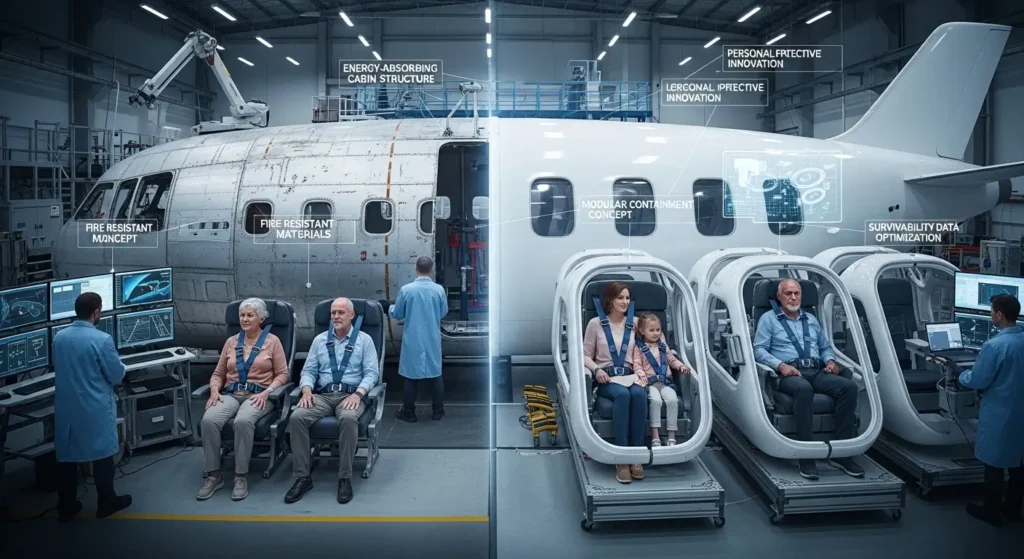
Modern commercial aircraft are engineering achievements. Structural reinforcement, fuel system protection, fire-resistant materials, and energy-absorbing seating all contribute to overall safety performance.
Yet there remains a conceptual gap between aircraft-level integrity and passenger-level isolation.
Aircraft systems are designed to:
- Maintain controlled flight
- Withstand structural loads
- Resist fire propagation
- Enable rapid evacuation
What they are not specifically designed to do is isolate individual passengers from environmental hazards following severe structural compromise.
This distinction is subtle but important.
For example:
- Cabin fire suppression systems focus primarily on cargo compartments and critical infrastructure.
- Structural deformation modeling aims to preserve survivable space but does not create individualized containment.
- Evacuation strategies assume accessibility to exits and functional mobility.
In other words, aircraft emergency protection systems prioritize collective survivability rather than personal containment.
The question for the future is not whether current systems are insufficient. Aviation safety records demonstrate their effectiveness. The question is whether a complementary layer of personal passenger safety systems could enhance resilience during extreme scenarios.
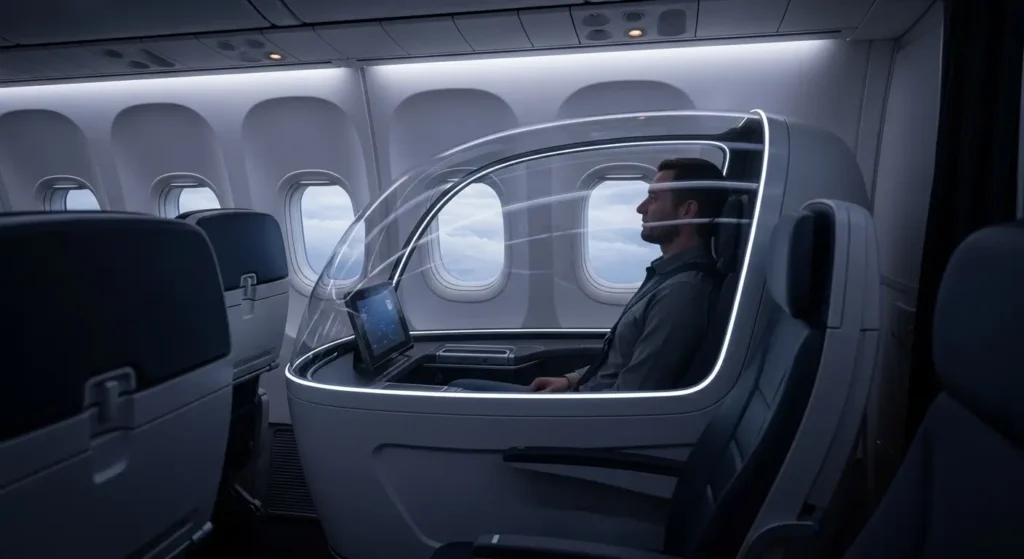
Isolation, in this context, refers to controlled separation from smoke, heat, debris, or environmental exposure for a limited but critical duration.
Bridging this conceptual gap requires redefining how survivability is modeled, measured, and engineered.
Environmental Control and Life-Support Considerations
Environmental control systems are among the most sophisticated subsystems in commercial aviation. They regulate cabin pressure, oxygen levels, temperature, humidity, and airflow distribution at cruising altitudes exceeding 30,000 feet.
However, survivability engineering invites a different perspective on environmental control.
During catastrophic events, environmental threats may include:
- Smoke inhalation
- Toxic combustion byproducts
- Rapid decompression
- Water intrusion
- Temperature extremes
Existing systems address many of these hazards through redundancy and evacuation protocols. For instance:
- Supplemental oxygen masks deploy automatically during decompression.
- Fire detection systems identify overheating in critical compartments.
- Emergency lighting supports evacuation in low-visibility conditions.
Yet these measures remain event-response solutions rather than contained life-support mechanisms.
Future frameworks within passenger survivability aviation may explore controlled micro-environments capable of sustaining breathable air, limiting smoke exposure, or delaying temperature escalation during critical windows.
Such concepts would require integration with:
- Cabin airflow architecture
- Structural load paths
- Electrical redundancy systems
- Weight and balance constraints
Life-support considerations introduce complex certification challenges. Oxygen supply duration, filtration mechanisms, and environmental sealing would all require rigorous validation under regulatory standards.
The broader implication is that survivability may evolve to include limited-duration protective environments rather than relying solely on evacuation speed.
This represents a philosophical shift in the future of aviation safety technology, from escape-based survival to engineered endurance within constrained timeframes.
Controlled Descent and Impact Mitigation Concepts
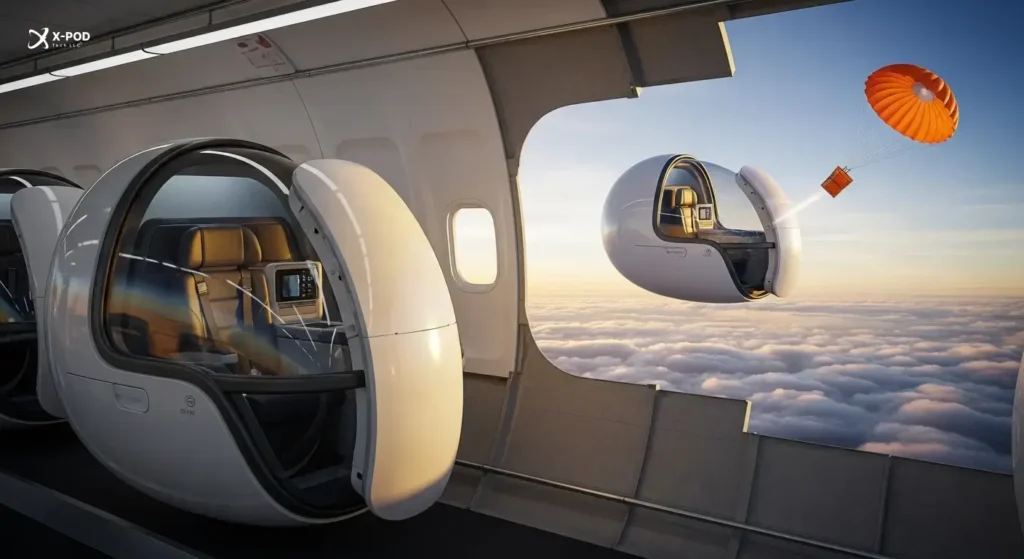
As survivability thinking matures, it expands beyond fire and environmental control into impact dynamics. Traditionally, crashworthiness research has focused on preserving structural integrity and dissipating kinetic energy across the airframe. Seats are tested for dynamic loads. Fuselage structures are reinforced to maintain survivable volume.
However, a dedicated passenger survivability aviation framework invites deeper exploration of controlled descent and localized impact mitigation concepts.
Controlled descent, in this context, does not imply replacing primary flight systems. Instead, it examines how secondary systems or modular architectures might influence vertical energy transfer during severe failure scenarios.
Key considerations include:
Energy Distribution
Impact forces are transmitted through structural pathways. Advanced materials, energy-absorbing substructures, or modular shock-isolation mechanisms could theoretically reduce localized force transfer to occupants.
Deceleration Management
Human survivability is directly influenced by deceleration rates. Engineering concepts that extend deceleration time, even fractionally, can significantly alter injury outcomes. This principle is widely applied in automotive crash systems and has relevance in aerospace research.
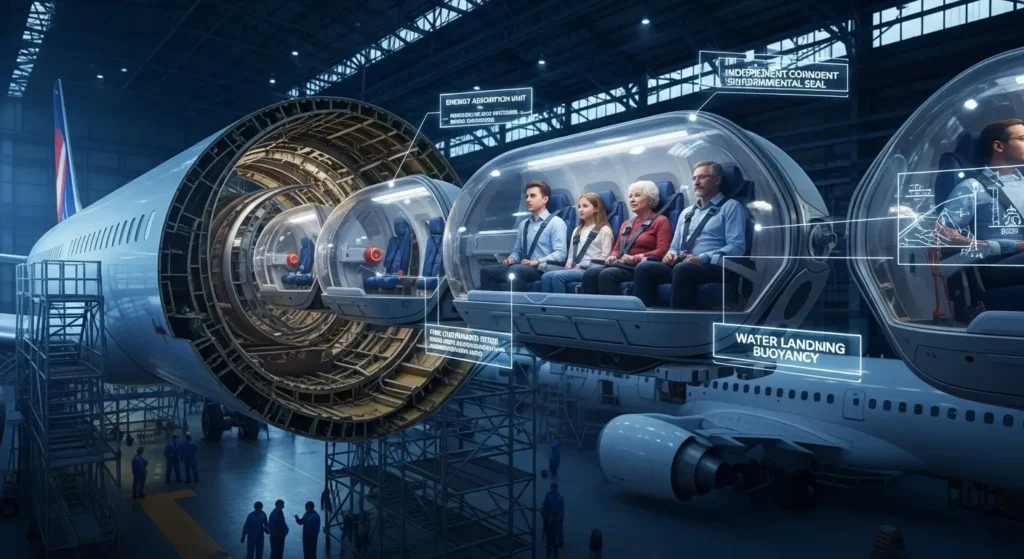
Spatial Containment During Structural Compromise
In extreme cases, structural deformation can create hazardous interior conditions. Modular design philosophies may explore methods of maintaining protected occupant volumes within broader fuselage compromise scenarios.
Water Impact and Buoyancy Stability
For overwater operations, impact mitigation intersects with flotation and post-impact stability. Survivability discussions increasingly consider time-to-rescue variables and how design influences survivable exposure windows.
These ideas remain engineering explorations rather than standardized implementations. Their importance lies not in immediate adoption, but in expanding the design vocabulary of aircraft emergency protection systems.
Survivability, when viewed through impact science, becomes a measurable and optimizable discipline rather than a reactive afterthought.
Regulatory and Industry Implications
Any meaningful shift in survivability philosophy must operate within the aviation regulatory ecosystem. Certification authorities prioritize proven reliability, statistical validation, and risk-based implementation.
Introducing new layers of passenger-focused safety would require:
- Clear performance benchmarks
- Defined survivability metrics
- Standardized testing protocols
- Demonstrable risk reduction
Historically, major safety advancements in aviation have followed this pathway. Fire-resistant cabin materials, reinforced cockpit doors, and advanced evacuation lighting systems all underwent rigorous evaluation before adoption.
A structured aviation safety innovation approach to survivability would likely involve phased integration:
- Research and modeling validation
- Limited supplemental certification pathways
- OEM collaboration
- Incremental regulatory harmonization
There are also economic considerations. Airlines, manufacturers, and regulators must balance added weight, system complexity, and cost against statistically measurable safety benefit.
This is why intellectual positioning matters. Thought leadership in this domain should not frame survivability as a reaction to fear. It should frame it as a systems-engineering extension of aviation’s historical safety culture.
If survivability becomes recognized as a defined discipline within the future of aviation safety technology, it could influence:
- Cabin architecture standards
- Performance-based certification models
- Research funding priorities
- OEM innovation roadmaps
The regulatory process may be gradual, but aviation history demonstrates that disciplined innovation eventually becomes embedded best practice.
Conclusion
Commercial aviation’s safety record is the result of relentless refinement. Prevention systems have achieved extraordinary reliability through layered redundancy and continuous learning.
The next frontier is not replacing prevention. It is complementing it.
Passenger survivability aviation proposes a structured framework where individual-level outcomes are analyzed with the same rigor applied to airframe performance or propulsion reliability.
By examining gaps between aircraft integrity and passenger isolation, exploring environmental control extensions, modeling controlled descent concepts, and engaging regulatory pathways, survivability can evolve into a measurable engineering discipline.
This is not a critique of existing systems. It is a recognition that safety evolution is continuous.
In the long arc of aerospace development, each generation redefines what is possible. Survivability thinking represents the next refinement in that progression.
The future of aviation safety will likely be shaped not only by preventing catastrophic events, but by systematically increasing the probability of survival should they occur.
And that distinction may define the next era of aviation safety leadership.