Introduction: Prevention vs. Survivability
Commercial aviation is built around prevention. Aircraft are engineered with multiple redundant systems, pilots undergo rigorous training, and global regulatory frameworks impose strict operational standards. These measures have made aviation statistically one of the safest modes of transportation worldwide.
However, when discussing aircraft crash survivability, it is important to distinguish between two separate concepts: prevention and survivability.
Prevention focuses on stopping an incident from occurring in the first place. This includes collision avoidance systems, predictive maintenance, air traffic control coordination, and structural integrity testing.
Survivability, on the other hand, examines what happens if prevention systems are overwhelmed. It asks a different set of questions:
- What protects passengers during impact?
- How does the cabin environment behave in a fire?
- What determines survival after a water landing?
- How quickly can evacuation occur?
These questions are not meant to undermine confidence in aviation. Rather, they reflect a mature engineering mindset. Every high-reliability industry evaluates both prevention and consequence mitigation.
Understanding survivability requires examining the types of catastrophic events that can occur, and how current systems respond to them.
Types of Catastrophic Events
Catastrophic aviation events are rare, but they vary in nature. Each scenario presents different survivability challenges.
Fire
Fire inside an aircraft cabin or cargo hold poses one of the most serious risks in aviation. Smoke inhalation is often a greater threat than flame itself. Modern aircraft fire protection systems include:
- Smoke detection sensors
- Fire suppression systems in cargo compartments
- Flame-resistant interior materials
- Emergency oxygen systems
Cabin materials are rigorously tested for flammability, heat release rate, and smoke density. These measures are designed to slow fire progression and allow time for emergency landing and evacuation.
Survivability in fire-related incidents often depends on containment speed, crew response, and environmental isolation.
Structural Failure
Structural failure may result from extreme mechanical stress, material fatigue, or external impact. Modern aircraft are designed with reinforced fuselage structures and redundancy to minimize the likelihood of catastrophic disintegration.
In rare structural compromise scenarios, survivability depends on:
- Impact energy distribution
- Seat anchoring integrity
- Cabin deformation patterns
- Secondary hazards such as fire or debris
Aircraft are tested to withstand significant loads beyond typical operational conditions. However, in severe structural events, passenger protection systems become critical to mitigating injury.
Water Impact
Water landings present a distinct survivability scenario. Unlike ground impact, water introduces buoyancy dynamics, potential flooding, and environmental exposure risks.
Aircraft are equipped with:
- Emergency flotation devices
- Life vests
- Rafts
- Evacuation slides that double as flotation devices
Post-crash survival aviation analysis shows that water landings can have higher survival rates than high-speed ground impacts, depending on angle, speed, and structural integrity at impact.
Survivability factors include rapid evacuation, flotation stability, and water temperature.
Runway Collisions
Ground collisions or runway overruns involve high kinetic energy transfer. These events may result in fuselage damage, landing gear collapse, or fire risk due to fuel ignition.
Aviation collision survival rates in such incidents vary significantly depending on speed at impact, angle of collision, and secondary hazards.
Again, survivability depends on a combination of structural resilience, restraint systems, and evacuation efficiency.
Current Passenger Protection Measures
Passenger protection systems have evolved steadily over time. While many focus on stabilizing occupants during sudden deceleration or turbulence, they play an important role in survivability scenarios.
Seatbelts and Restraint Systems
Seatbelts are designed primarily to prevent injury during turbulence and sudden deceleration. By securing passengers to their seats, restraint systems reduce the risk of secondary impact within the cabin.
In crash dynamics, seat anchoring strength and restraint integrity significantly influence injury outcomes. Properly fastened seatbelts remain one of the simplest yet most effective passenger-level safety measures.
Brace Positions
Brace positions are scientifically studied postures intended to minimize flailing injuries during impact. Research conducted over decades has examined how body positioning affects head, neck, and limb injury patterns.
While not widely understood outside aviation, brace protocols are based on impact biomechanics and aim to reduce secondary trauma during deceleration events.
Emergency Evacuation Systems
Evacuation remains a cornerstone of passenger survival strategy. Aircraft are certified to evacuate all passengers within 90 seconds under specific conditions.
Emergency systems include:
- Slide deployment systems
- Clearly illuminated exit pathways
- Crew-led evacuation protocols
- Emergency lighting and signage
Post-impact survivability often hinges on rapid evacuation, particularly in scenarios involving fire.
These measures collectively form the foundation of modern passenger protection systems. They are designed to manage specific risk factors within the cabin environment.
However, as aviation technology continues to evolve, discussions are expanding beyond stabilization and evacuation toward deeper survivability considerations.
Limitations of Existing Cabin-Level Safety
Despite the sophistication of modern aviation, aircraft crash survivability is still influenced by one core reality: most commercial aircraft are not designed around individualized protection systems. Instead, the safety philosophy centers on protecting the aircraft as a whole and enabling rapid evacuation if an accident occurs.
Current cabin-level safety measures face several inherent limitations:
- Exposure to Secondary Hazards
After impact, passengers may face fire, smoke inhalation, toxic fumes, structural collapse, or water submersion. While aircraft fire protection systems are highly advanced in engines and cargo compartments, cabin areas rely largely on evacuation rather than containment.
- Time Sensitivity
Post-crash survival aviation research shows that survival often depends on minutes or even seconds. Smoke inhalation, for example, can incapacitate individuals quickly. Evacuation protocols assume mobility, visibility, and structural integrity… conditions that may not always exist.
- Dependency on Passenger Behavior
Safety procedures require passengers to follow instructions precisely: bracing correctly, evacuating quickly, leaving belongings behind. In reality, panic, confusion, injury, or poor visibility can compromise these actions.
- Structural Deformation and Impact Forces
While aircraft seats are designed to absorb certain levels of force, survivability varies significantly depending on crash dynamics. Aircraft are engineered to dissipate energy across the airframe, but localized impacts can create unpredictable conditions within the cabin.
- Limited Individualized Protection
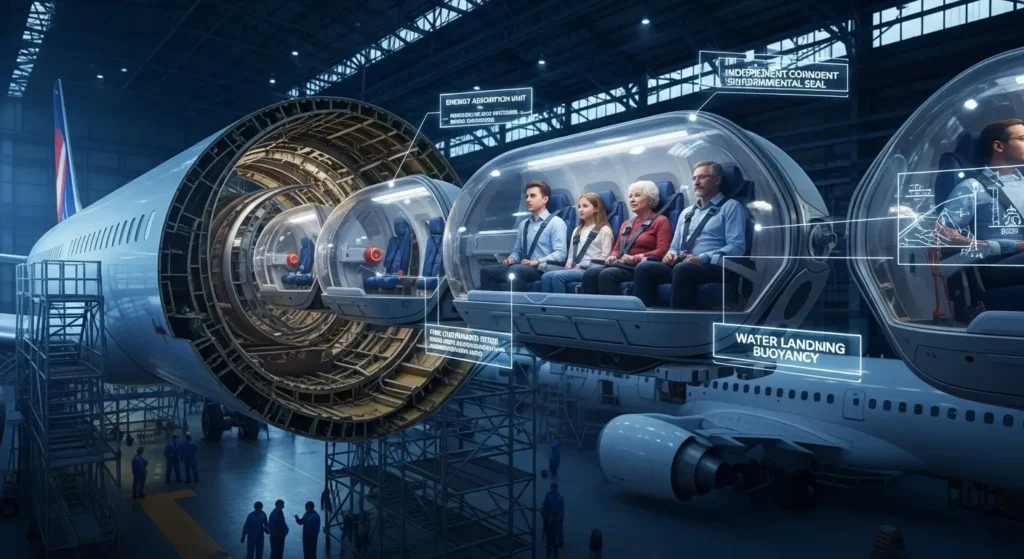
There are no dedicated passenger protection systems that isolate individuals from fire, debris, or post-impact environmental hazards. Protection is collective, not modular.
This does not suggest a failure of aviation safety – far from it. Rather, it highlights that survivability engineering has historically been secondary to accident prevention. As prevention rates improve, the next frontier naturally becomes improving outcomes when rare catastrophic events occur.
Understanding these limitations is essential to advancing the conversation in a rational and engineering-focused way.
Engineering Approaches to Increasing Survival Probability
As discussions around aircraft crash survivability evolve, engineers and researchers are increasingly exploring ways to enhance survival probability beyond traditional cabin measures.
This shift reflects a broader systems-engineering perspective: if prevention is maximized, survivability optimization becomes the logical next step.
Several approaches are being explored in aviation research and adjacent industries:
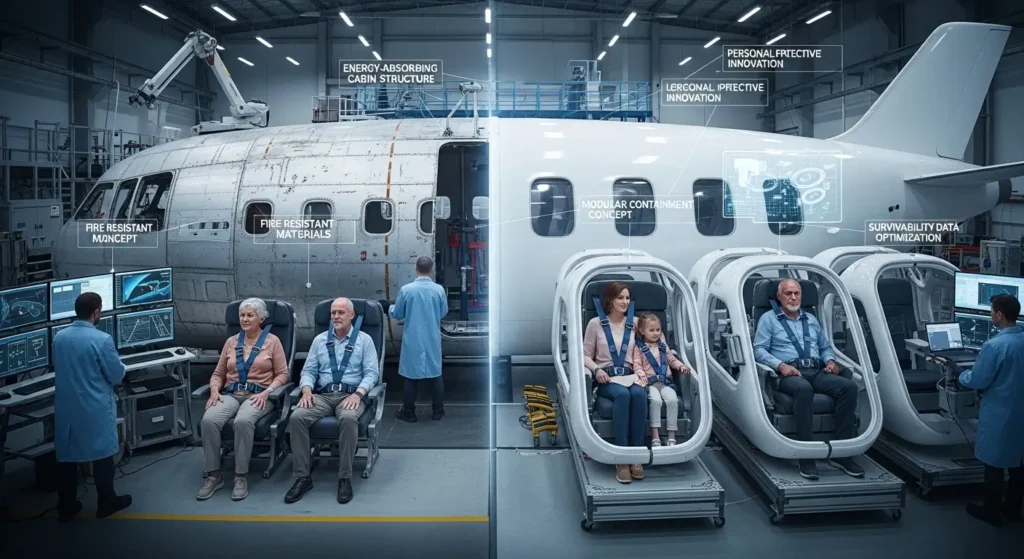
Energy-Absorbing Cabin Structures
Advancements in composite materials and structural design allow for better energy distribution during impact. Crashworthiness research focuses on controlling deformation pathways to preserve survivable space.
Advanced Fire-Resistant Materials
Improved cabin materials with lower flammability, reduced toxic smoke output, and better heat resistance can extend survivable time windows during post-crash fire scenarios.
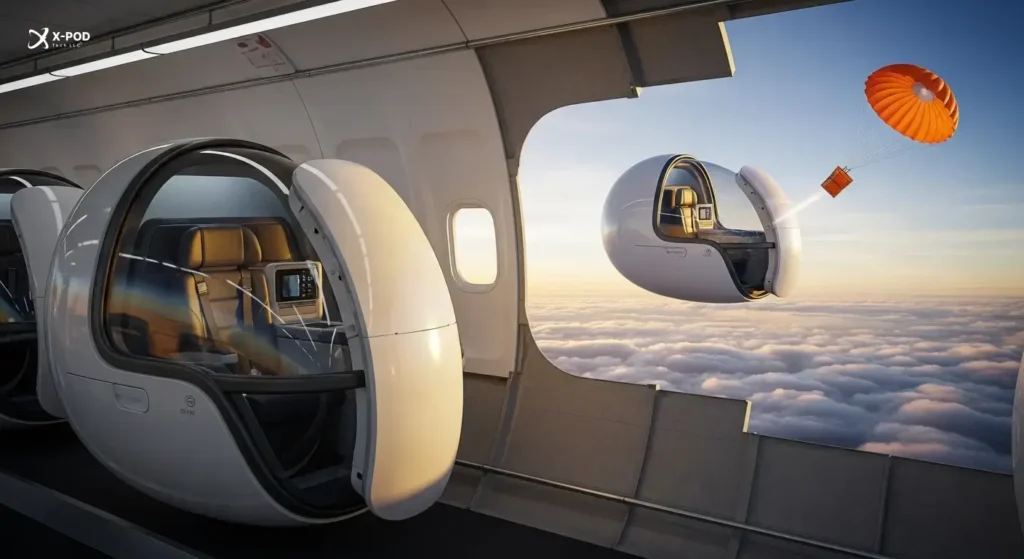
Modular Containment Concepts
Some research discussions explore isolating passengers from environmental hazards such as smoke, fire, or water intrusion. These concepts aim to create temporary survivable environments until rescue or evacuation occurs.
Personal Protective Innovations
Although still largely conceptual in commercial aviation, the idea of personal protective systems has emerged in broader safety engineering conversations. These systems would focus on shielding individuals from debris, smoke inhalation, or secondary impacts.
Data-Driven Safety Enhancements
Modern aircraft generate vast amounts of flight data. Post-incident analysis helps engineers identify survivability variables, including cabin layout optimization, seat orientation, and material performance.
It is important to emphasize that such innovations require rigorous testing, certification, and regulatory approval. Aviation safety improvements are never implemented lightly. The industry’s strength lies in its methodical approach.
Engineering for survivability does not replace prevention – it complements it.
Conclusion
Aviation remains one of the safest modes of transportation in the world. That safety record is built on relentless innovation, careful regulation, and a culture of learning from every incident.
Yet safety is not static.
The conversation around aircraft crash survivability represents the next natural progression in aviation engineering. As prevention systems become more sophisticated, attention increasingly turns toward improving outcomes in rare catastrophic events.
Understanding the difference between prevention and survivability helps remove fear from the discussion. It reframes the topic not as alarmist speculation, but as responsible engineering evolution.
Continuous innovation has always defined aviation progress, from early structural reinforcements to modern aircraft fire protection systems and advanced evacuation protocols. The same disciplined mindset now informs discussions around enhancing post-crash survival aviation outcomes.
Survivability is not a contradiction to safety. It is an extension of it.
And in aviation, evolution never truly stops.