The story of commercial aviation is, at its core, a story of engineering refinement. From early propeller-driven aircraft carrying only a handful of passengers to today’s long-haul wide-body jets transporting hundreds across continents, safety has remained the industry’s defining priority.
The aviation passenger safety evolution has not occurred through a single breakthrough. Instead, it has progressed through layers of innovation: structural improvements, procedural safeguards, regulatory oversight, and technological advancements working together to reduce risk. Commercial aviation today is statistically one of the safest modes of transportation in the world. That achievement is the result of decades of data analysis, accident investigation, material science advancement, and systems engineering.
Yet safety is not static. Each decade introduces new design philosophies, new materials, and new risk assessments. What was once considered sufficient protection becomes a baseline for future improvement. As aircraft become more efficient and global traffic continues to rise, the question shifts from prevention alone to survivability as well.
Understanding where passenger safety began provides context for where it may evolve next.
Early Safety Milestones
The aircraft safety systems history of commercial aviation is marked by incremental but transformative milestones. Many of the features now taken for granted were once groundbreaking advancements.
Seatbelts and Restraint Systems
The introduction of seatbelts in commercial aircraft cabins represented one of the earliest passenger-level safety measures. Initially intended primarily for turbulence protection rather than crash survival, restraint systems significantly reduced in-flight injury rates.
Over time, seatbelt standards improved in strength, anchoring mechanisms, and compliance requirements. Regulatory bodies mandated their use during take-off, landing, and turbulent conditions. While simple in concept, restraint systems marked a fundamental shift: acknowledging that passengers required dedicated protective measures, not just structural aircraft integrity.
However, restraint systems alone were never designed to address extreme catastrophic events. Their primary role has remained impact stabilization within a structurally intact cabin.
Pressurized Cabins
Cabin pressurization revolutionized long-distance air travel. By allowing aircraft to fly at higher altitudes above turbulent weather systems, pressurized cabins improved both passenger comfort and safety.
Before pressurization became standard, altitude limitations restricted routes and exposed aircraft to more atmospheric instability. With pressurization came structural reinforcement of fuselages, improved environmental controls, and oxygen delivery systems.
This milestone did more than enhance comfort. It reflected a broader engineering philosophy: designing aircraft interiors as controlled environments rather than passive compartments.
Fire Suppression and Material Advancements
Fire remains one of the most serious risks in any transportation system. In aviation, confined cabin spaces and altitude constraints amplify that risk.
Over decades, regulatory bodies introduced increasingly strict flammability standards for cabin materials. Flame-resistant seat fabrics, improved wiring insulation, smoke detection systems, and onboard fire suppression mechanisms became mandatory components of modern aviation safety technology.
Material science advancements significantly reduced the speed at which cabin fires could spread. At the same time, crew training protocols for fire response became more standardized and rigorous.
These innovations focused heavily on containment and mitigation. The objective was to prevent escalation and allow safe landing or evacuation. Survivability, in this context, depended on rapid procedural response combined with structural resilience.
Structural vs. Passenger-Level Protection
As aviation matured, engineering emphasis increasingly centered on airframe durability, redundancy, and system reliability. Modern aircraft are designed with multiple backup systems, reinforced fuselage structures, and fail-safe redundancies intended to prevent catastrophic failure.
Structural integrity became the cornerstone of safety strategy.
Aircraft manufacturers invested heavily in:
- Redundant avionics systems
- Reinforced fuselage frames
- Improved impact absorption in landing gear
- Advanced navigation and collision avoidance systems
- Real-time diagnostics and predictive maintenance
These developments dramatically reduced accident rates. Prevention became the primary focus. The industry’s philosophy evolved around eliminating the likelihood of catastrophic scenarios altogether.
However, this structural emphasis created a subtle gap in the broader aircraft survivability systems conversation.
Most safety innovations protect the aircraft as a system. They aim to maintain control, prevent structural compromise, or enable safe evacuation. Passenger-level isolation during extreme failure events has historically been secondary to aircraft-level integrity.
In other words, the assumption has long been that if the aircraft structure holds, passengers remain protected. If it does not, survivability depends largely on the nature of the impact, emergency response speed, and environmental conditions.
Cabin safety innovations have certainly advanced — from improved brace position research to more efficient evacuation slides — but they generally operate within the framework of a structurally intact or partially intact fuselage.
This distinction between structural protection and passenger-level survivability is becoming increasingly relevant as aviation traffic grows and risk modelling evolves.
The next stage of safety discussion may not solely revolve around preventing failure, but around mitigating consequences when prevention is no longer possible.
The Shift Toward Survivability Engineering
As aviation systems have become more reliable, accident rates have declined significantly. Yet rare catastrophic events still occur. When they do, the outcome often depends not only on aircraft design but on survivability factors within the cabin environment.
This reality has gradually introduced a new layer of discussion within aerospace engineering: survivability engineering.
Survivability engineering focuses on increasing the probability that occupants can endure extreme scenarios, even when primary aircraft systems fail. Rather than concentrating solely on prevention, this discipline evaluates what happens after structural compromise, onboard fire, or uncontrolled descent begins.
Several areas are drawing increased attention:
- Energy absorption during impact
- Post-impact fire containment
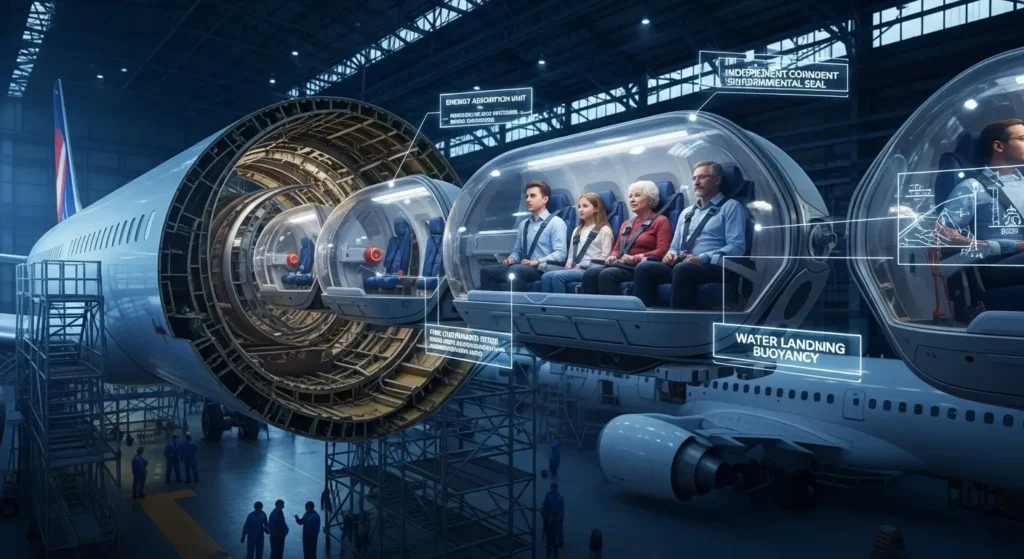
- Rapid environmental isolation
- Water landing flotation support
- Controlled descent mitigation systems
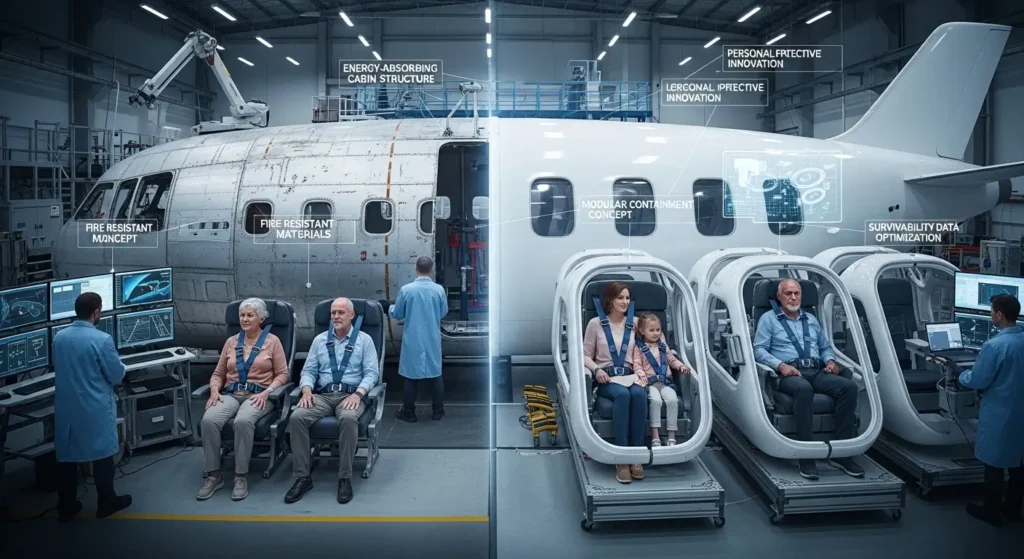
Historically, survivability enhancements have been applied primarily at the structural level. Reinforced fuselage frames, improved crashworthiness standards, and advanced fire-resistant materials all contribute to overall aircraft resilience.
However, engineers and safety analysts are increasingly examining passenger-level isolation strategies. The question is no longer limited to “How do we prevent accidents?” but extends to “How do we protect occupants if prevention measures are overwhelmed?”
This shift reflects a broader pattern seen across high-risk industries. In automotive design, crumple zones and airbags supplement seatbelts. In spaceflight, crew capsules are engineered for independent survival in the event of booster failure. In maritime engineering, lifeboat systems are designed for complete detachment from compromised vessels.
In aviation, a similar framework is emerging: layered safety, where passenger survivability systems operate independently of primary aircraft integrity.
This does not replace structural protection. It adds redundancy at the human level.
The Next Phase of Aviation Safety
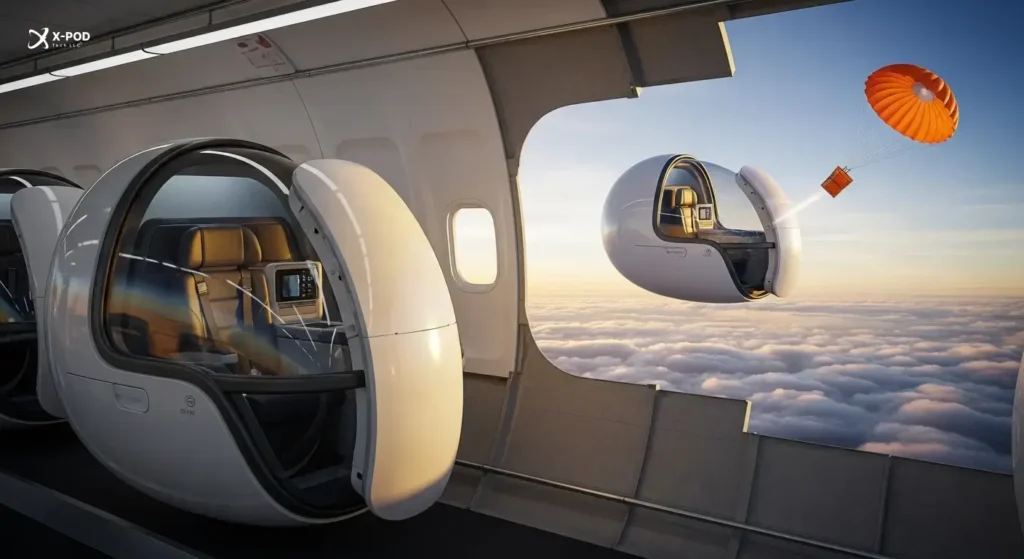
The next phase of aviation passenger safety evolution may center on modular survivability platforms integrated directly into cabin architecture.
Modular systems introduce a different engineering approach. Instead of relying solely on a single unified cabin structure, protection can be compartmentalized or distributed across independent units within the aircraft interior.
This framework supports several potential advantages:
- Isolation from smoke and fire propagation
- Independent environmental sealing
- Structural reinforcement at the passenger level
- Scalable integration across aircraft types
- Adaptability for both OEM installation and retrofit
Modular survivability concepts do not suggest abandoning conventional safety systems. Rather, they function as an additional safety layer that operates when traditional aircraft-level systems can no longer provide sufficient protection.
As global aviation traffic continues to grow, aircraft cabins are carrying more passengers across longer routes. At the same time, regulatory scrutiny and public expectations around safety continue to increase. The industry has consistently responded to such pressures with innovation.
Cabin design has historically prioritized efficiency, weight optimization, and comfort. Yet cabin architecture may also become an active participant in survivability strategy.
In parallel, advancements in materials science, lightweight composites, environmental control systems, and controlled descent mechanisms are expanding what is technically feasible. Concepts once considered speculative are now being evaluated through serious engineering research.
The next stage of modern aviation safety technology may therefore involve rethinking the cabin not only as a transport space, but as a survivability environment.
Safety Evolution Is Ongoing
Commercial aviation’s safety record is not the result of a single invention. It is the cumulative outcome of continuous improvement across decades of engineering discipline.
From early restraint systems and pressurized cabins to advanced avionics redundancy and fire-resistant materials, each generation has built upon the last. The aircraft safety systems history of the industry demonstrates a clear pattern: progress occurs when emerging risks are addressed before they become normalized.
Today’s conversation is gradually expanding beyond structural prevention to include passenger-level survivability frameworks. This shift does not imply existing systems are inadequate. On the contrary, it reflects aviation’s long-standing culture of proactive refinement.
The aviation passenger safety evolution is far from complete.
As aircraft designs continue to advance and global travel expands, safety innovation will remain a dynamic process. Survivability engineering, modular cabin concepts, and distributed protection systems represent part of a broader exploration into how layered safety can further strengthen aviation’s already remarkable record.
Every milestone in aviation safety once began as a forward-looking concept.
The next one may already be under discussion.